


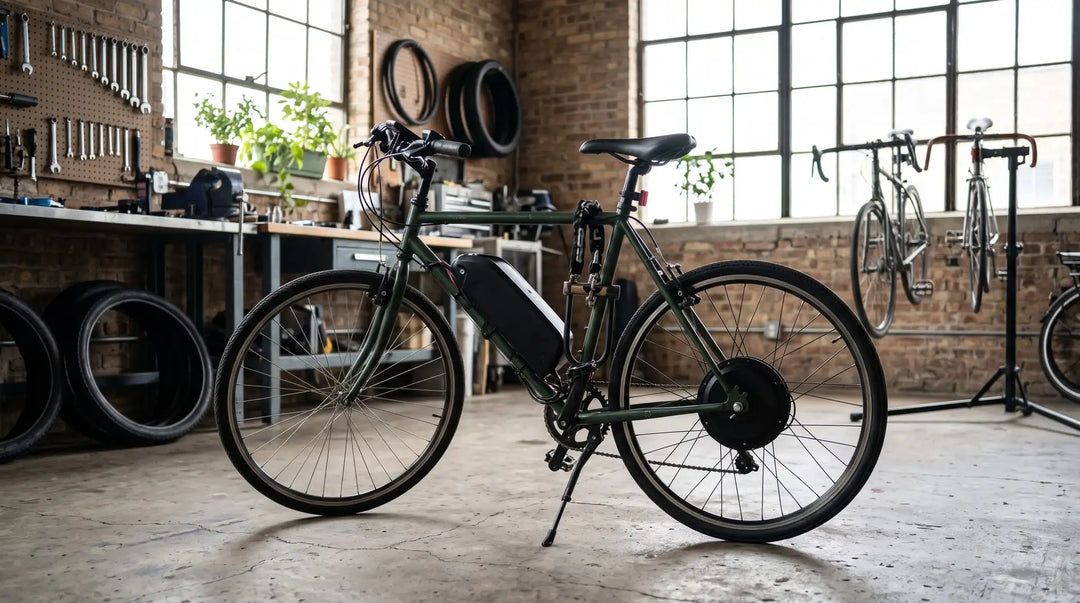
Illinois has rewritten its e-bike laws, and DIY builders want to know: do you need insurance for a converted e-bike? It depends on your motor wattage and top speed. A low-power conversion is still classified as a bicycle under the law, while a high-power build is subject to motorcycle-style regulations beginning January 1, 2027.
At eBikeling, we help riders turn regular bikes into electric ones with our e-bike conversion kits. Below, we break down what Senate Bill 3484 changes and how the right e-bike insurance protects you.
Illinois E-Bike Insurance Rules at a Glance
Illinois tightened its rules as e-bike injuries climbed nationwide: CPSC injury data shows 46% of all estimated e-bike injuries from 2017 to 2022 occurred in 2022 alone. Here's how the new Illinois e-bike insurance requirements apply to a converted e-bike from January 1, 2027:
| Your Converted E-bike | Legal Category | Driver's License | Title and Registration | Liability Insurance |
|---|---|---|---|---|
| Motor under 750W, assist stops at 20 mph (Class 1 or 2) | Low-speed electric bicycle | No | No | Not required |
| Motor under 750W, pedal assist stops at 28 mph (Class 3) | Low-speed electric bicycle | No | No | Not required |
| Motor above 750W (up to 8,000W), or faster than 28 mph | Motor-driven cycle | Yes | Yes | Required |
How Illinois E-Bike Laws Treat Converted Bikes
Illinois law doesn’t create a separate category for converted e-bikes. Your build is subject to the same rules as a factory-built e-bike.
What Counts as a Low-Speed Electric Bicycle
Under the Illinois Vehicle Code, a low-speed electric bicycle has fully operable pedals and a motor of less than 750 watts. It must fit Class 1 (pedal assist up to 20 mph), Class 2 (throttle up to 20 mph), or Class 3 (pedal assist up to 28 mph). Riders have the same rights and duties as regular cyclists, so they don’t need a driver's license, registration, or e-bike insurance. Learn more in our overview of e-bike law changes.
Why Your Speed Settings Matter
Illinois law says no person shall knowingly tamper with or modify the speed capability of a low-speed e-bike without updating its classification label. Unlocking a bike to exceed its class speed limit can reclassify it as a motor-driven cycle. Because a converted e-bike has no factory label, keep your kit receipt, motor spec sheet, and a record of your speed settings.
What Changes on January 1, 2027 Under SB 3484
Gov. JB Pritzker signed Senate Bill 3484 (Public Act 104-0854) in August 2026, and it takes effect on January 1, 2027. Here are the changes that matter most for converted e-bikes.
The New Motor-Driven Cycle Category
The law defines a motor-driven cycle as a vehicle with an electric motor rated above 750 watts and up to 8,000 watts. E-bikes that don’t meet the low-speed definition also fall into this category.
According to Capitol News Illinois, riders will need a driver's license, insurance, a title, and state registration. These bikes are regulated much like motorcycles, must stay off bike lanes and paths, and their riders are subject to DUI laws, WBEZ reports. Illinois joins New Jersey in requiring insurance for high-speed e-bikes, according to Insurance Journal.
The Registration Catch for Converted E-Bikes
Under SB 3484, a motor-driven cycle must have a vehicle identification number (VIN), a speedometer showing miles per hour, and conform to all federal vehicle safety standards. Vehicles that don't qualify "shall not be eligible for registration." A home-built conversion usually has no VIN or federal certification, which can make it difficult to ride a high-power build on public roads legally. Bikes purchased before January 1, 2027, are exempt from titling requirements, but those that qualify as motor-driven cycles must be titled and registered for public road use.
New Statewide Riding Rules
Riders must be at least 15 for Class 1 and 2 e-bikes and 16 for Class 3. Riders under 18 can't carry passengers, except their siblings or children. Low-speed e-bikes may use streets, bike lanes, paths, and trails, but not sidewalks. The law also prompts local e-bike ordinances, but park and forest preserve districts can still set rules for paths under their jurisdiction.
Which E-Bike Conversion Kits Need Insurance in Illinois?
The power of your electric bike conversion kit decides which rules apply. Here's how common kit sizes compare under the 2027 rules.
500W Geared Kits
A 500W e-bike conversion kit is well below the 750-watt line. Set the display to cut motor assistance at 20 mph (or 28 mph with pedal assist only) to keep your converted e-bike within the low-speed electric bicycle classification. That means no license, no registration, and no mandatory e-bike insurance in Illinois.
750W Geared Kits
A 750W geared conversion kit sits right on the legal line. The low-speed definition says "less than 750 watts," while the motor-driven cycle definition starts "greater than 750 watts," so a motor rated at exactly 750W doesn’t fall cleanly into either. Before riding on public roads after January 1, 2027, confirm your classification with the Secretary of State and keep speed settings within class limits.
1200W to 3000W Direct Drive Kits
High-power kits like our 1200W, 1500W, 2000W, and 3000W direct drive systems exceed 750 watts and can easily pass 28 mph. Starting in 2027, these builds will be classified as motor-driven cycles. Because they may not meet the law’s VIN requirements, they’re generally better suited for private property and off-road use.
Why E-Bike Insurance Is Smart Even When It's Not Required

Many riders assume their existing policies already cover their electric bike. That often isn’t the case.
Homeowners and Renters Policies May Not Cover You
According to Verisk, ISO's 2022 homeowners forms revision added e-bikes to the "motor vehicle" definition and lets insurers exclude liability coverage for non-owned e-bikes. Insurance Journal, citing Verisk, also reports an increase in claims related to battery fire risks. Ask your agent in writing whether your policy covers theft, fire, damage, and liability for a converted e-bike.
Liability, Theft, and Damage Coverage Options
Liability coverage protects you if you injure someone or damage their property. A standalone e-bike insurance policy can cover liability, battery or motor theft, and crash damage. It’s optional for a low-speed converted e-bike, but all motor-driven cycles must carry liability coverage.
How to Insure a Converted E-Bike in Illinois
Follow these steps to keep your converted e-bike legal and protected:
- Check your motor wattage and top speed using your kit's spec sheet and a GPS app.
- Pick your category. Stay under 750W within Class 1, 2, or 3 limits for the simplest path.
- For a high-power build, check registration eligibility first. Confirm VIN and federal safety requirements with the Illinois Secretary of State before you ride on public roads.
- Buy liability insurance that meets state minimums. The Department of Insurance lists $25,000 per person and $50,000 per accident for bodily injury, plus $20,000 for property damage.
- Review your home or renters policy and add a standalone e-bike policy if needed.
-
Keep your documents handy, including your kit receipt, motor specs, and insurance card.
Ride Legal and Protected in Illinois
So, do you need insurance for a converted e-bike in Illinois? If your build stays under 750 watts and within class limits, no, though it’s still recommended to get optional e-bike insurance. Starting January 1, 2027, high-power motor kids will be subject to licensing, titling, registration, and insurance requirements.
At eBikeling, we build e-bike conversion kits for every rider, from 500W commuters to 3000W performance setups. Unsure which kit fits Illinois e-bike laws? Our team is happy to help.


